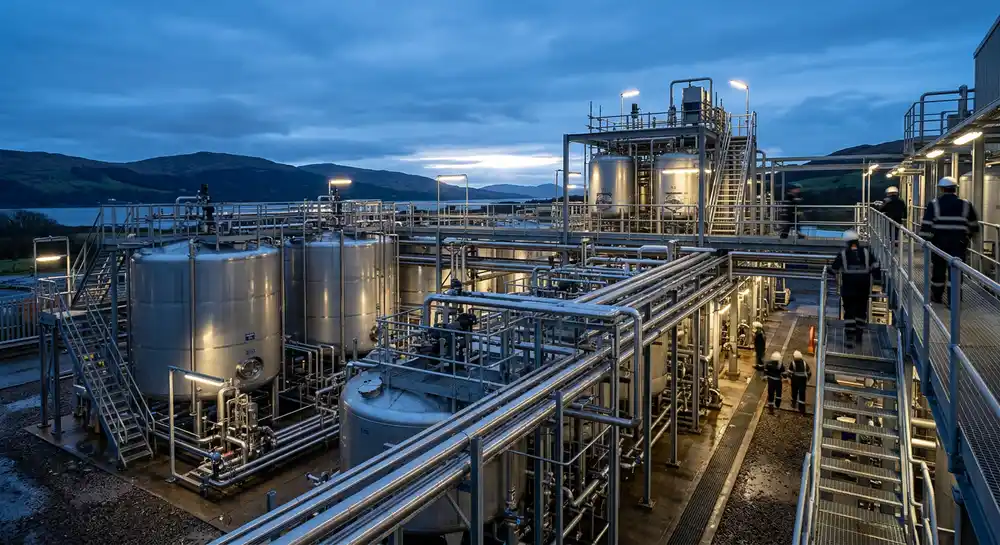
Celtic Renewables, the Scottish company that converts whisky industry by-products into green chemicals, has appointed Hanne Risbjerg Sørensen as chief executive as it prepares to take its technology to full commercial scale.
She succeeds co-founder Mark Simmers, who has moved into the role of founder and strategy director, as The Herald reported.
An industrial biotech specialist
Risbjerg Sørensen brings more than 25 years of experience in industrial biotechnology and renewable energy. At the Danish energy company Ørsted she led the Renescience business, gaining experience of developing, commissioning and operating first-of-a-kind industrial technology. Earlier in her career she held roles at Novozymes.
That background speaks directly to the challenge Celtic Renewables now faces: moving a proven process out of a demonstration plant and into a much larger industrial facility.
Explaining her decision to join, she said: “I was attracted to Celtic Renewables by the opportunity to work on a low-carbon industrial project that brings together biotechnology, commercialisation, strategy, commissioning, operations and people leadership.”
“My experience at Ørsted, particularly with Renescience, has shown me both the possibilities and the challenges of moving innovative technology towards industrial application,” she said.
She added: “I look forward to building on the foundation established by Mark and the team, strengthening our commercial and operational performance, and working with partners and investors to prepare Celtic Renewables for its next stage.”
Board backs a change of gear
Brett Simpson, chair of Celtic Renewables, paid tribute to Simmers’ role in building the business and bringing the demonstrator biorefinery to its current stage. “We are now focused on the next phase of development,” he said. “Hanne combines deep technical understanding with commercial and operational leadership, including first-hand experience of commissioning and operating first-of-a-kind industrial technology.”
The company uses fermentation to turn residues from whisky production and potato processing into bio-based acetone, butanol and ethanol. Those chemicals are used in pharmaceuticals, speciality chemicals, cosmetics and personal care, and offer an alternative to versions made from fossil fuels.
According to Scottish Financial Review, the next phase includes strengthening operations, advancing commercial opportunities and raising the investment needed for a first-of-a-kind full-scale industrial facility.
The process is designed to make use of waste materials and residues, supporting a circular approach to industrial production. Distilleries supply pot ale, a liquid residue of whisky making, which would otherwise need to be disposed of. In April the company renewed a three-year supply agreement with Rosebank Distillery in Falkirk, which had supplied more than 4,600 tonnes of pot ale to the Grangemouth site over the previous three years, according to ChemXplore.
Why the timing matters
The leadership change follows a year of progress on funding. In March, Celtic Renewables announced £16.23 million in public and private backing, including money from Scottish Enterprise, its existing investors and the Grangemouth Just Transition Fund, to plan and develop a new industrial-scale biorefinery at Grangemouth, as Biofuels International reported at the time.
That new plant has been described as a £120 million project with around ten times the production capacity of the current demonstration biorefinery. Delivering it will require further investment, and the board’s choice of chief executive suggests it wants a leader who can reassure investors that the technology can be built and run reliably at that scale.
Founder-led companies often reach a point where the skills needed to invent and prove a technology differ from those needed to build and run a large plant. Bringing in an executive who has already taken first-of-a-kind technology through commissioning is a clear statement that Celtic Renewables sees itself entering that second phase.
Keeping Simmers in a strategy role also preserves continuity with investors, partners and distillery suppliers who have backed the company since its early days.
What it means for Glasgow and the west of Scotland
Grangemouth sits within easy reach of Glasgow, and its industrial future has been one of Scotland’s biggest economic questions since the closure of the refinery there. Low-carbon manufacturing projects such as Celtic Renewables are seen as part of the answer, offering skilled jobs that build on the area’s long chemical and engineering heritage.
The company’s model also ties into Scotland’s whisky industry, turning a by-product of distilling into a higher-value product. If the full-scale plant proceeds, it would deepen links between the drinks sector and advanced manufacturing across central Scotland.
What happens next
Risbjerg Sørensen’s immediate priorities will be operational performance at the existing biorefinery and securing the investment for the larger facility. The pace at which Celtic Renewables can close that funding will be the key measure of its new leadership over the coming year.