New research on generating oxygen from water could help support long term missions to the Moon and Mars.
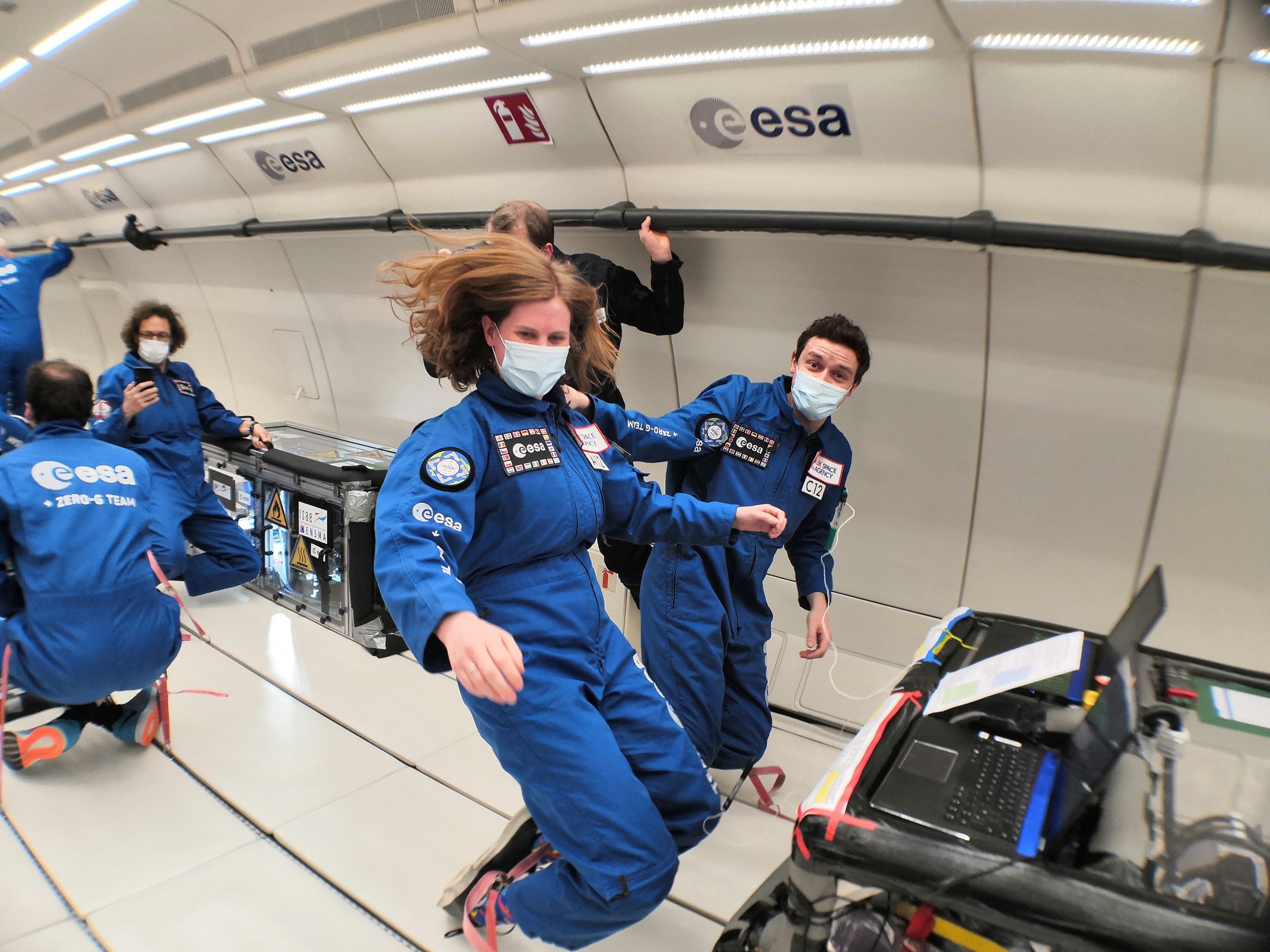
Researchers at the University of Glasgow took a series of flights into microgravity to study how differing gravitational pulls of planets could affect the process of electrolysis.
Electrolysis uses electrical current to split water into its constituent gases, hydrogen and oxygen. Oxygen is vital to space missions for astronauts to breathe and fuel their rockets.
Current space missions carry the oxygen they require in bulky tanks, but as plans to establish permanent bases on the Moon and Mars gather pace scientists propose finding sources instead.
These sources could be in the form of ice which may be present on both planetary surfaces.
Electrolysing the melted ice could free missions from the need to carry all of their own oxygen and help proposed long term habitations like NASA’s Artemis lunar station become self-sustaining.
The process of electrolysis on earth is well understood but much less is known about how it might function in lower gravity environments like Mars.
In a new paper published in Nature Communications, the research team led by Dr Bethany Lomax described how they set out to find answers to this.
They designed and built an experiment to take into the microgravity environments created during parabolic flights.
During parabolic flights aircraft create brief periods of weightlessness by flying in alternating upwards and downwards arcs.
Aboard a plane flown from an airport in Germany by the European Space Agency and Novespace the researchers deployed four electrolysis cells built into a small centrifuge.
By doing so they were able to recreate the microgravity of the Moon and Mars and measure the oxygen bubbles created at the electrodes of each cell.
The results suggested that electrochemical cells would produce 11% less oxygen in lower gravity if more power were not supplied to compensate.
Dr Bethany Lomax a lead author of the paper and PHD student at the University of Glasgow took part in the flights with co-authors Patrick McHugh and Paul Broadley.
Dr Lomax, now a research fellow at the European Space Agency, said: “There seemed to be a gap in previously reported work, where the drop in efficiency at gravity levels relevant to the Moon and Mars was not looked into experimentally.
“The experiments that we were able to do onboard the microgravity parabolic flights aimed to fill that gap.
“The process of taking the flights to get those results was challenging, not just the nausea of the constant climbs and drops during the parabolas but also in arranging to travel from the UK to Germany during the pandemic.
“The whole team worked really hard to get the experiment ready in time for flight.
“However, it was worth for it the observations we were able to make, which we hope will be of real use to future space mission planners.”
Researchers from the Universities of Glasgow and Manchester, the European Space Research and Technology Centre in the Netherlands and the Johns Hopkins University Applied Physics Laboratory in the United States contributed to the paper.
The paper, titled ‘Predicting the efficiency of oxygen-evolving electrolysis on the Moon and Mars’, is published in Nature Communications.
The research was supported by funding from the European Space Agency’s Networking/Partnership Initiative, the UK Space Agency, the Engineering and Physical Sciences Research Council (EPSRC), the Institution of Mechanical Engineers, and the Royal Society.